Redrawn every day
A distribution grid is invisible on purpose: buried, overhead, and unnoticed until it stops. The only place the whole of it exists at once is on paper — and that paper had to be redrawn and reprinted every day, or the crews carrying it were working from a grid that no longer existed.
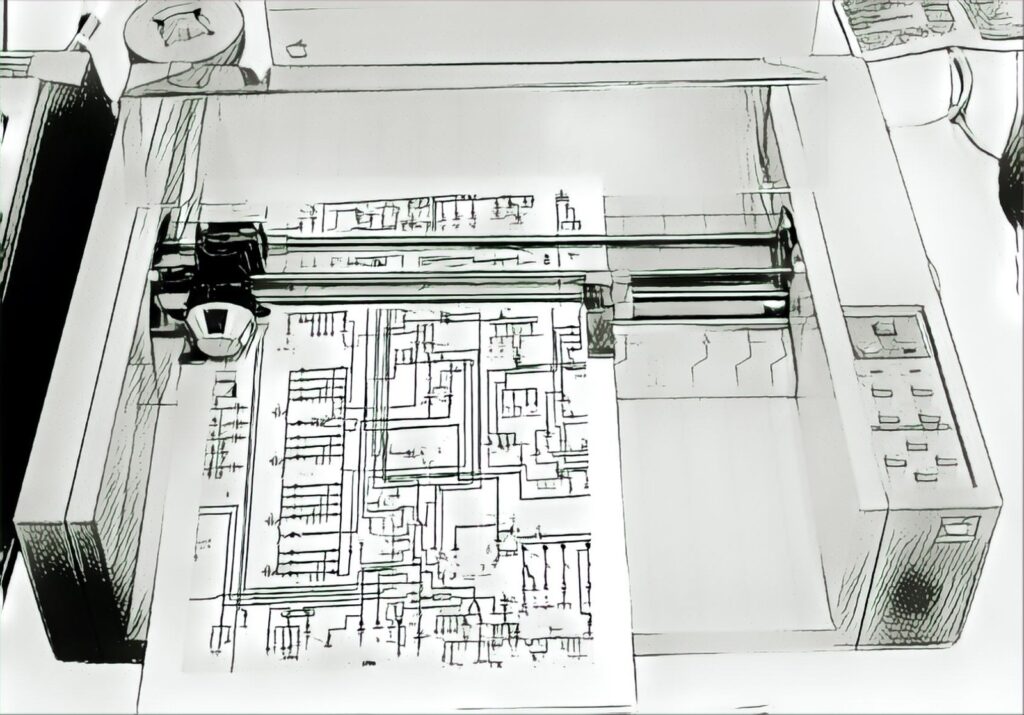
Above: a pen plotter of the era, with a 1979 utility circuit-diagram board composited onto its bed. Neither photograph is from Edison; together they show how the maps were made and roughly how they looked.
The stuck thing
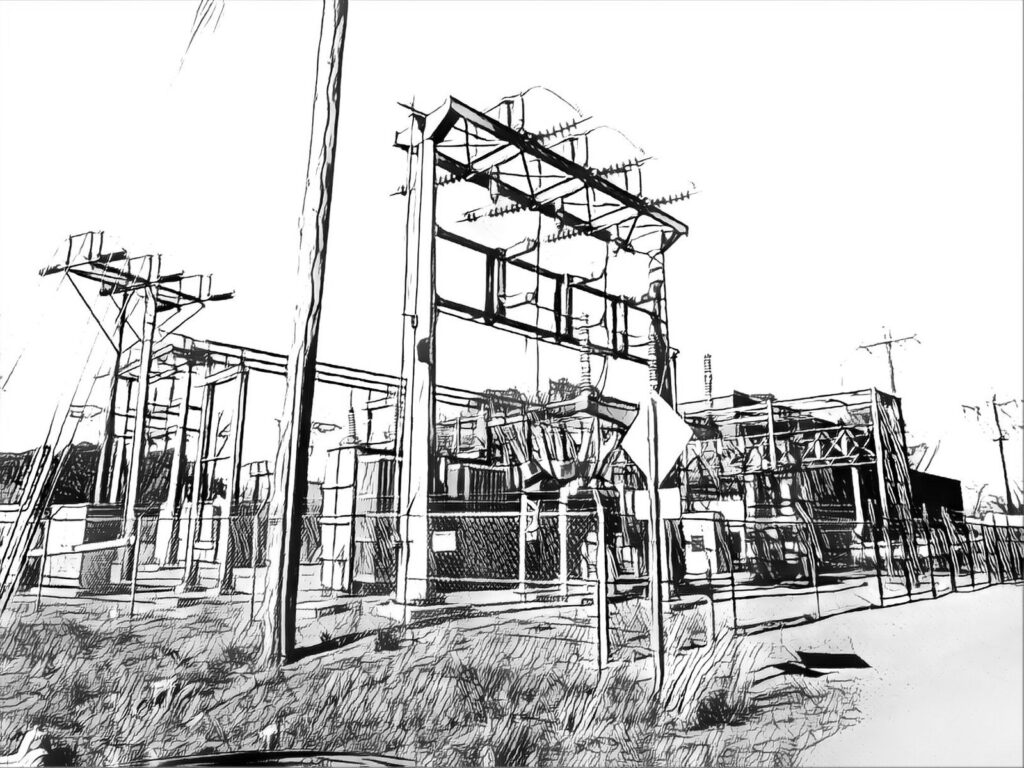
The Cathedral City yard served the desert east of the mountains — Palm Springs, Palm Desert, and the long rural runs between them. Seen from the map room, that territory is not places. It is circuits: voltage stepped up to carry distance and stepped back down to serve capacity, arranged with failsafes meant to contain a fault rather than pass it along.
Things fail in ordinary ways. A substation transformer overheats and gives up. A bird with enough wingspan bridges two conductors that are insulated by nothing but the air between them, and takes out a segment on its way to being killed by it.
Against that, the grid changes constantly — circuits rebuilt, new runs built out, components added for load. Every one of those changes came down from the engineers as an order form, and every crew that rolled out in the morning carried a paper picture of the system they were about to work on. A picture one day old is not slightly wrong. It is wrong in exactly the places where someone has recently been working.
The diagnosis
The map is not a record of the grid. It is the instrument the grid is operated with.
That reframing changes what kind of problem the map room is. Producing it is not clerical work that happens after the engineering; it is a daily operations constraint with a hard deadline — the moment the trucks leave — and a distribution problem attached, because the sheet has to reach the specific crew whose work it changes.
Made it go
The warehouse, first rotation. Riser kits, built to order: insulators, connectors, switches, fuses and the rest, pulled against a work order, wrapped and protected as each part required, crated for the truck. The parts list is the design; the crate is the design made portable. Some orders called for instruments — among them synchroscopes, which spin to show a lineman when a segment has come back into phase with the live system and can safely be reconnected. Trifluoro chloroethane for degreasing connections. Rags that had been someone’s clothing.
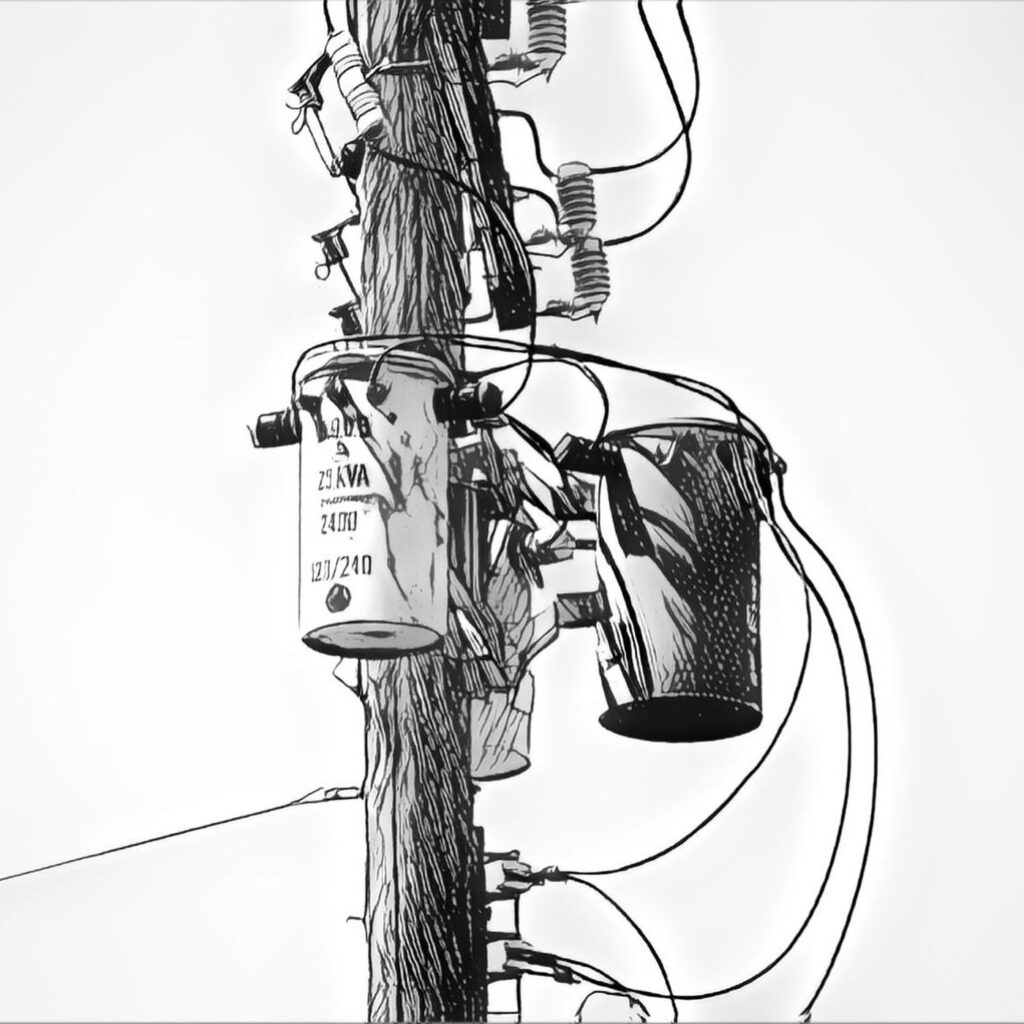
Then the yard: transformers and poles onto trucks with a forklift and a Hyster boom. First heavy equipment, two years before Morgan Corporation.
The field, mid-summer. Groundman on a line crew in desert heat: pulling heavy conductor, digging trench, and learning to work from the trucks — and to drive them, the first stick shift. This is the rotation where the map meets the dirt, and where the distance between a drawing and a trench becomes obvious.
Summer intern is the bottom of the ladder, and on a utility yard the ladder is the organizing fact. Everyone there was permanent, older, senior. Nothing about having done well at school counted for anything, nor should it have. Learning to be the most junior person present — and useful anyway — is the part of that summer that transferred furthest.
Map production. The maps were large format, ledger size, folded page over page and quick-bound into booklets. Nancy ran the drafting: engineering’s order forms in, circuit changes out, worked in CAD at a speed that came from a three-button mouse and years of knowing exactly what the next change would be. A pen plotter drew each sheet in vector, swapping colored pens as it went.
My part was the production and the distribution: making sure the booklets got made and reached the right crews before they left in the morning, and that a critical change reached the crew it affected first rather than in whatever order the stack happened to be in. Nancy did the drawing the day before and briefed me on what had to go where and what took priority.
On call. Several days at a stretch living at the station on emergency standby for fire repairs, sleeping and eating there, ready to roll. Good overtime, long waiting. Never deployed into a zone.
What it started
This was the summer between freshman and sophomore years of engineering school, before the switch to cognitive science. It is also the earliest instance of the thing this site keeps returning to.
A UI specification written by authors on three continents. A permit set addressed to an inspector who will never see the porch. A remediation plan that moved an insurer. A proposal that won a thirty-by-forty-foot bay. Each is the same object: a document somebody acts on when you are not standing there.
The first one was a circuit map, and it had to be right by morning.
high-voltage field operations · heavy equipment · production drafting & distribution · circuit systems at regional scale
Image credits. None of these photographs is from Southern California Edison; each stands for a kind of object rather than a specific one, and all have been processed to this site’s sketch treatment. Plotter: Apple Color Plotter crop by Marcin Wichary, CC BY 2.0, via Wikimedia Commons; adapted. Circuit diagram board: Circuit Diagram Boards in Electrical Distribution Office, Hank Seidel for NASA, 1979, public domain, via the National Archives; adapted and composited onto the plotter. Distribution pole: by TJH2018, CC0 1.0; adapted. Substation: Delmarva Power Grace Street Substation by Tonyglen14, CC BY 2.0, via Flickr; adapted.
← All work · Have a stuck thing? Tell me about it →